THE WYCLIFFE BIBLE, Matthew 19:10-12
(regarding the “… let him …” corruption)
A supplement to JESUS “COMMANDS” TO NOT MARRY
(I stuck this on a separate page so the former images which people link to, have the same file order name.)
John Wycliffe (WYC) translated “very closely” the New Testament from the Latin Vulgate into Middle English in 1380 AD.
http://www.bibledbdata.org/onlinebibles/wycliffe_nt/40_019.htm, Read the Wycliffe New Testament, “Matthew 19”:
19:10 His disciplis seien to him, If the cause of a man with
a wijf is so, it spedith not to be weddid.
19:11 And he seide to hem, Not alle men taken this
word; but to whiche it is youun.
19:12 For ther ben geldingis, whiche ben thus born of the modris wombe; and ther ben geldyngis, that ben maad of men; and there ben geldyngis, that han geldid hem silf, for the kyngdom of heuenes. He that may take, `take he.
Why do they have the “ ` ” (grave accent) just before the last “take,” where “let him” is in the corrupted English?
Well, here’s another source:
http://books.google.com/books?id=dm6Y3L2FxXYC&printsec=frontcover&dq=%22The+New+Testament+in+English+according+to+the+version+by+John+Wycliffe%22&source=bl&ots=GF6cNtFVg0&sig=Yc009cywTr5qxs1OC6RHgvxrwOM&hl=en&ei=f_IiTfCRL9SknQeDt5DkDQ&sa=X&oi=book_result&ct=result&resnum=1&ved=0CBcQ6AEwAA#v=onepage&q&f=false, The New Testament in English according to the version by John Wycliffe, p. 40, (Matthew 19):
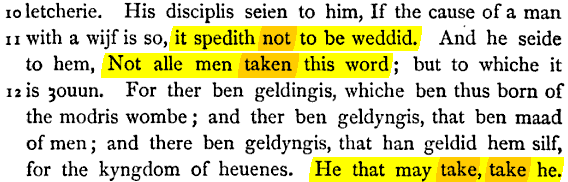
In text:
10 … His disciplis seien to him, If the cause of a man
11 with a wijf is so, it spedith [prosperous] not to be weddid. (11)And he seide to hem, Not alle men taken this word; but to whiche it
12 is gouun. (12)For ther ben geldingis, whiche ben thus born of the modris wombe; and ther ben geldyngis, that ben maad of men; and there ben geldyngis, that han geldid hem silf, for the kyngdom of heuenes. He that may take, take he.
Translated from Middle English:
10 … His disciples said to him, If the cause of a man
11 with a wife is so, it speeded [prosperous] not to be wedded. (11)And he said to him, Not all men taken this word; but to which it
12 is given. (12)For there been geldings, which been thus born of the mother’s womb; and there been geldings, that been made of men; and there been geldings, that has [from habben] gelded himself, for the kingdom of heavens. He that may take, take he.
Another source:
http://www.archive.org/stream/holybiblecontain04wycluoft#page/51/mode/1up, The Holy Bible, containing The Old and New Testaments, with the Apocryphal Books, in the Earliest English Versions: Made from the Latin Vulgate by John Wycliffe and His Followers, edited by The Rev. Josiah Forshall and Sir Frederic Madden, Oxford, vol. IV, p. 51, 1850, “MATTHEW | CAP. XIX.” (Matthew 19):
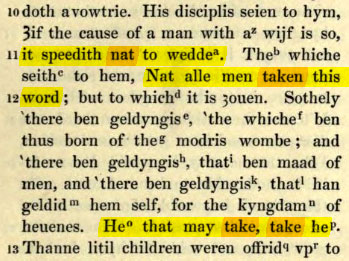
Another text source that’s more translated:
http://www.biblegateway.com/passage/?search=Matthew+19&version=WYC, Matthew 19 (Wycliffe New Testament):
10 His disciples say to him, If the cause of a man with his wife is so, it speedeth not to be wedded [it speedeth not to wed].
11 And he said to them, Not all men take this word; but they to which it is given [but to whom it is given].
12 For there be geldings, which be so born of the mother's womb [which be thus born of their mother's womb]; and there be geldings, that be made of men; and there be geldings, that have gelded themselves, for the kingdom of heavens. He that may take, take he.
Tyndale’s 1525 translation:
The erroneous added “… let him …” is included in the 1582 Catholic Douay Rheims Version, which is also supposed to be translated from the same Latin, and also in Tyndale’s 1525 New Testament (TYN) which was supposed to be translated from the original Greek:
http://www.studylight.org/desk/?l=en&query=Matthew+18§ion=2&translation=tyn&oq=mt%252018&new=1&nb=mt&ng=18&nnc=%A0%3E%3E%A0&ncc=18, Tyndale New Testament (1526), “Book of Matthew” “19:1-30”:
10 Then sayde his disciples to him: yf the mater be so betwene man and wyfe then is it not good to mary. 11 He sayde vnto them: all me can not awaye with that sayinge save they to whom it is geve. 12 Ther are chaste which were so borne out of their mothers belly. And ther are chaste which be made of men. And ther be chaste which have made them selves chaste for the kyngdome of heves sake. He that can take it let him take it.
Same (… let him …) is in the Miles Coverdale (MCB-1535), Bishop’s (BIS-1568), Geneva (GEN-1587) Bibles.
So, I’m guessing that the corruption occurred during the Renaissance.